Hungarian pengő
Hungary · 1927–1946
1927→194619 yrs
Peak monthly inflation: 41.9 quadrillion%
Doubling time at peak: 15 hours
The worst hyperinflation in recorded history. Post-WWII reparations and reconstruction debt destroyed the currency — by July 1946, prices were doubling every 15 hours. The largest denomination ever printed: 100 quintillion (1020) pengő. Replaced by the forint in August 1946 at a ratio of 4×1029:1.
Metal removal: the early pengő had silver 2-pengő (.640) and 5-pengő (.640 fine) coins, 1929–1939. Silver eliminated from circulating pengő in 1939 (replaced by aluminum-bronze and steel during WWII). Coinage debasement preceded the catastrophic 1945–46 hyperinflation by 6 years.
Hyperinflation
Papiermark
Weimar Germany · 1914–1923
1914→19239 yrs
Peak monthly inflation: 29,500%
Doubling time at peak: ~3.7 days
The textbook hyperinflation. War-financing through money printing — Germany suspended gold convertibility in 1914 — led to runaway price increases by 1922. Workers paid twice a day, wages spent before they'd lose half their value by evening. 1 USD = 4.2 trillion marks by November 1923. Replaced by the Rentenmark, then the Reichsmark.
Metal removal: pre-1914 German Mark had silver ½, 1, 2, 3, 5 mark coins (.900 fine) and gold convertibility. Both were eliminated in August 1914 as the war began. Coins were melted for the war effort and replaced with iron, zinc, and emergency paper Notgeld. The currency that died in 1923 had been demonetized of metal nine years earlier.
Hyperinflation
Zimbabwean dollar
Zimbabwe · 1980–2009 (and again 2019–)
1980→200929 yrs
Peak monthly inflation: 79.6 billion%
Doubling time at peak: 24.7 hours
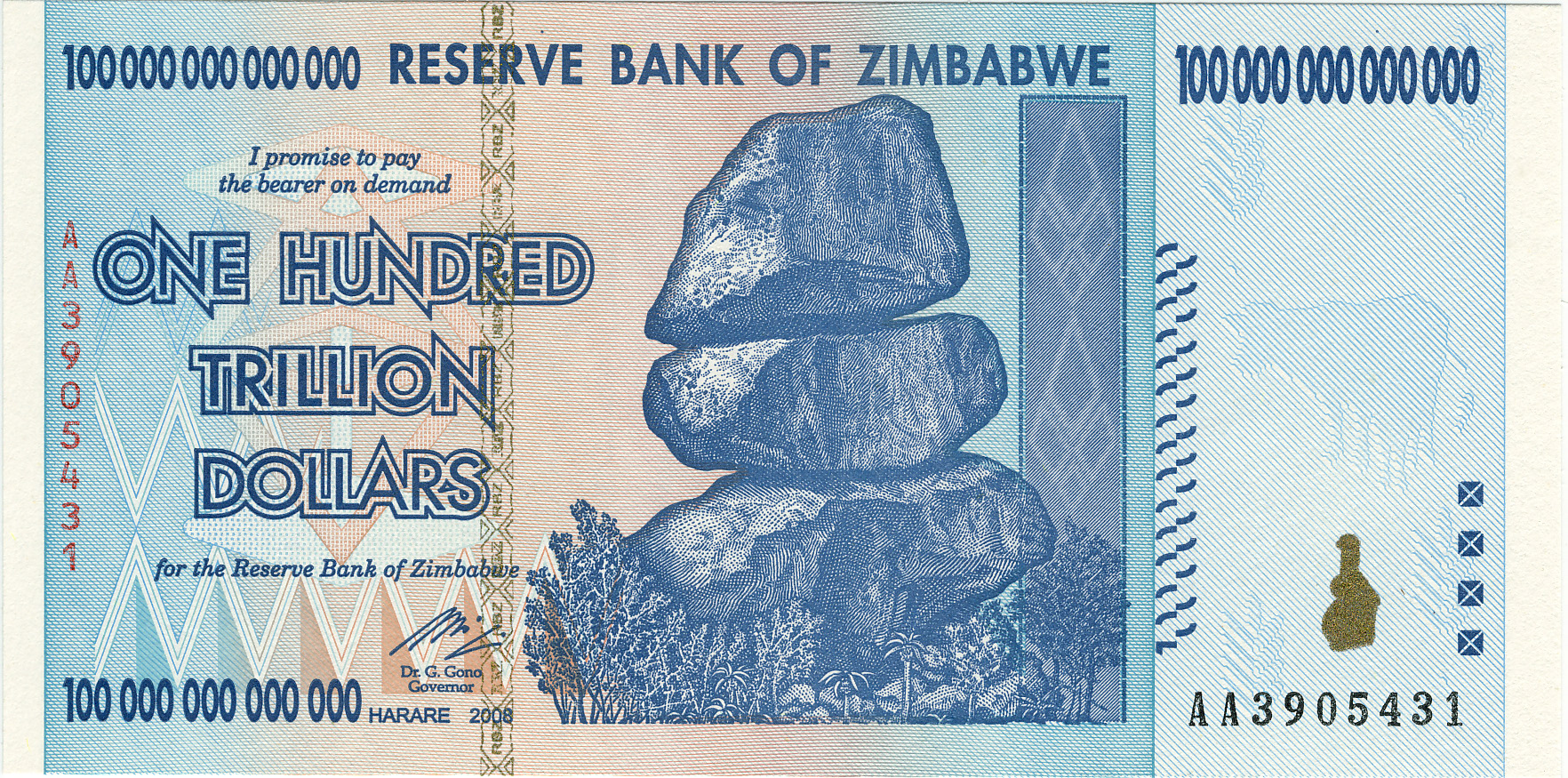
Land redistribution and money printing under Mugabe destroyed the currency through the 2000s. The notorious 100 trillion dollar note issued in 2008 wouldn't buy a loaf of bread by the time it printed. Officially abandoned in 2009 in favor of US dollars and South African rand. A "second Zimbabwe dollar" relaunched 2019 is on the same trajectory.
Metal removal: the Zimbabwe dollar never had silver or gold backing. Circulating coins (1c, 5c, 10c, 25c, 50c, $1, $2, $5) were base-metal nickel-plated steel from the start (1980). The currency had no metal anchor to debase from — it was 100% fiat from issue, which may explain how fast the collapse compounded.
Hyperinflation
Venezuelan bolívar
Venezuela · 1879–ongoing
1879→2024+redenominated 3×
Peak monthly inflation (Jan 2019): ~197%
Cumulative loss since 2008: ~14 zeros
Three redenominations in 13 years (2008, 2018, 2021) collectively chopped 14 zeros off the currency. By 2018, paying with stacks of bolívares took longer than weighing them. Many Venezuelans switched to US dollars and crypto by 2020. The currency continues to circulate but functions as a unit of fast-decaying account, not store of value.
Metal removal: Venezuelan bolívares had .835 silver coins (½, 1, 2, 5 bolívares) from 1879 through 1965, when silver was eliminated. Modern bolívar coins are nickel-clad steel. The metal removal predated the 1980s currency-control crises by 15+ years and the 2008 hyperinflation by four decades.
Hyperinflation
Yugoslav dinar
Yugoslavia · 1992–1994 (final hyperinflation phase)
1992→19942 yrs
Peak monthly inflation: 313 million%
Doubling time at peak: 34 hours
The worst European hyperinflation since the 1940s, driven by sanctions, war, and money printing during the Yugoslav breakup. The 500 billion dinar note (issued 1993) was the highest-denomination European banknote ever printed. Replaced by the “new dinar” in January 1994 at 13 million:1.
Hyperinflation
Continental currency
United States · 1775–1781
1775→17816 yrs
End-of-life value: <1% of issue value
Idiom: “Not worth a Continental”
The first US fiat currency, issued by the Continental Congress to finance the Revolutionary War. Britain printed counterfeits to accelerate the collapse. By 1781 the bills traded at 1/100th of face. The phrase “not worth a Continental” entered the American vocabulary — and the lesson echoed in the gold-standard arguments of the next century.
Metal removal: Continentals were paper-only from issue — no metal backing of any kind. Spanish 8 reales and other foreign silver coinage circulated alongside as the actual hard money of the colonies. The lesson stuck: the US Constitution's coinage clause specifically required gold and silver after the Revolution, and the dollar (1792) was defined by silver weight (371.25 grains) for nearly a century after.
Hyperinflation
Argentine peso (multiple)
Argentina · 1881–ongoing
1881→2024+5 redenominations
Cumulative zeros chopped: 13
2023 inflation: 211%
Argentina has redenominated its currency five times since 1969 — peso ley (1970), peso argentino (1983), austral (1985), peso convertible (1992), and the current peso. Each reset cut multiple zeros; cumulative dilution since 1969 is roughly 1013:1. The 2023 hyperinflation under Milei's predecessor pushed inflation to 200%+, the worst since 1991.
Metal removal: Argentina had .900 silver peso coins (1, 2, 5, 10, 25, 50 centavos) from 1881 to 1942, when silver was eliminated under wartime pressures. Subsequent peso iterations (peso ley 1970+) had no metal at all. Each currency reset since has been fully fiat from issue.
Hyperinflation
Lebanese pound
Lebanon · 1939–ongoing
1939→2024+~98% loss since 2019
2019 rate: 1,500 LBP / USD
2024 rate: 89,500 LBP / USD
A controlled fiat currency that lost ~98% of its value in five years following the 2019 banking crisis. Banks froze deposits, capital controls trapped savings, and the official peg to the dollar disintegrated. Many Lebanese now transact exclusively in USD or crypto; the pound functions as a small-purchase token only.
Metal removal: Lebanon had silver pound coins (.600 fineness) issued under French mandate in 1929. Silver was removed by 1952 when the modern Banque du Liban took over. Subsequent base-metal coinage (1, 2½, 5, 10, 25, 50 pounds) is nickel-brass and aluminum-bronze. The 67-year gap between metal removal and the 2019 crisis fits the long-fuse pattern.
Hyperinflation
Confederate dollar
Confederate States of America · 1861–1865
1861→18654 yrs
End-of-life value: 0 (war loss)
Issued to finance the Confederate war effort. Backed by future cotton sales contingent on Confederate independence. When that didn't arrive in April 1865, the bills became collectible paper. Worth more today as numismatic curiosities than they were worth in 1865.
War / collapse
Reichsmark
Nazi / occupied Germany · 1924–1948
1924→194824 yrs
End-of-life ratio: 10:1 to Deutsche Mark
The successor to the hyperinflated Papiermark; the Nazi-era and post-war German currency. Hidden inflation (price controls during the war years) produced an enormous monetary overhang by 1945. The 1948 currency reform replaced it with the Deutsche Mark at 10 RM → 1 DM for cash — effectively wiping out 90% of postwar German savings overnight.
Metal removal: early Reichsmark coinage included silver 2 RM and 5 RM (.500 and .900 respectively) from 1925 to 1933. Silver content reduced to .625 in 1934, then eliminated entirely by 1939 as Nazi rearmament absorbed precious metals. Wartime coinage was zinc and aluminum. The full demonetization happened a decade before the 1948 reform that ended the currency.
War / collapse
Soviet ruble
USSR · 1917–1991
1917→199174 yrs
1991–1998 inflation: 80%+ peak monthly
A controlled fiat for 70 years — price-controlled and unconvertible — until the Soviet Union dissolved. The post-USSR Russian ruble inherited the chaos: hyperinflation through 1992–94, then a 1998 redenomination at 1,000:1. Old Soviet rubles are now museum pieces.
Metal removal: the Tsarist ruble (predecessor) was a silver coin of 18g (.900) and gold coins were freely convertible until WWI. The Soviet ruble issued silver 50-kopeck and 1-ruble coins from 1921 to 1931, then eliminated silver. Subsequent Soviet coinage was cupronickel and aluminum-bronze for the next 60 years.
War / collapse
Roman denarius
Roman Empire · 211 BC–c. 270 AD
211 BC→270 AD~480 yrs
Silver content at start: 95%
Silver content at death: <5%
The textbook coin debasement story. Started as a 95% silver denarius under the Republic. Successive emperors — Nero, Caracalla, Gallienus — reduced silver content over centuries to fund military expansion and donatives. By the late 3rd century the denarius was a copper coin with a silver wash. Hyperinflation, military mutinies, and the Third Century Crisis followed. Replaced by Diocletian's reforms.
War / collapse
Iraqi dinar (Saddam-era)
Iraq · 1932–2003
1932→200371 yrs (Saddam-issue replaced)
1990 rate: ~0.3 IQD / USD (1 dinar ≈ US$3)
2003 rate: ~3,500 IQD / USD
Once a strong oil-backed currency, the Iraqi dinar collapsed under sanctions and Gulf War financing through the 1990s. After the 2003 US invasion, the new Iraqi dinar (without Saddam's portrait) replaced the “Saddam dinar” at par. Old Saddam dinars now circulate in numismatic markets only.
Metal removal: the Iraqi dinar issued silver 50-fils and 100-fils coins (.500 fine) from 1932 to 1959. Silver was eliminated as the Hashemite monarchy fell. Subsequent base-metal coinage (and the Saddam-era replacement) had no precious-metal content. The 1990 sanctions-driven collapse came 31 years after silver removal.
War / collapse
East German mark
East Germany · 1948–1990
1948→199042 yrs
1990 conversion: 1:1 to 2:1 (DM)
The currency of the GDR for 41 years. Following reunification, East Germans converted savings to Deutsche Marks at 1:1 (up to limits) or 2:1 (above limits). Not technically “hyperinflated” — but a controlled currency that ceased to exist when the regime issuing it dissolved.
Regime change
Czechoslovak koruna
Czechoslovakia · 1919–1993
1919→199374 yrs
Survived two world wars and 40 years of communism. Died with the “Velvet Divorce” in 1993, when Czechoslovakia split into the Czech Republic and Slovakia. Replaced by the Czech koruna and Slovak koruna respectively. The Slovak koruna itself died in 2009 when Slovakia joined the Euro.
Regime change
Deutsche Mark
West Germany / Germany · 1948–2002
1948→200254 yrs
Conversion: 1.95583 DM / EUR
The most respected post-war fiat currency — Germany's hard-money rebuild after the Reichsmark debacle. Stable for half a century. Voluntarily abandoned for the Euro in 2002. Many Germans still mentally double Euro prices to compare to DM-era costs — a cultural memory of monetary discipline.
Metal removal: the 5 DM coin was minted in .625 silver from 1951 to 1974, then switched to cupronickel-clad. The 10 DM commemorative silver coins (.625, then .925) ran through 2001. The DM was the modern fiat that retained circulating silver content longest among Western currencies, which may correlate with its perceived hardness.
Absorbed (Euro)
French franc
France · 1795–2002
1795→2002207 yrs
Conversion: 6.55957 FRF / EUR
A direct descendent of the silver-content franc germinal of 1803 (4.5 g silver). Survived two World Wars, the Algerian War, and de Gaulle's 1960 redenomination (100:1). Voluntarily replaced by the Euro in 2002. The longest-lived major European fiat currency.
Metal removal: silver francs (5 fr at .835) circulated until 1959, when silver was removed. Bronze 5/10/20-centime coinage replaced with aluminum-bronze, then plated steel. By 2002 (the Euro changeover) the franc had been silver-free for 43 years — the absorption was orderly because the metal anchor was already gone.
Absorbed (Euro)
Italian lira
Italy · 1861–2002
1861→2002141 yrs
Conversion: 1,936.27 ITL / EUR
Born with Italian unification, died with monetary union. The lira lost ~99.95% of its value over its lifespan — an Italian newspaper that cost 1 lira in 1861 cost 1,800 lira by 2002. Italians used the conversion to consolidate; the lira's slow death made the Euro look hard by comparison.
Metal removal: silver lire (1, 2, 5 L at .835) ran from 1861 through the 1920s. Silver eliminated by 1928. The 500-lira commemorative silver coin (.835) ran 1958–2001 as a collector issue, but circulating lira coinage was aluminum and stainless steel from the 1950s onward.
Absorbed (Euro)
Spanish peseta
Spain · 1869–2002
1869→2002133 yrs
Conversion: 166.386 ESP / EUR
Replaced the Spanish escudo in 1869 as Spain joined the Latin Monetary Union. Originally tied to a silver standard (5 g silver per peseta). Survived the Spanish Civil War and the Franco era. Voluntarily absorbed into the Euro in 2002.
Metal removal: .900-silver pesetas (1, 2, 5 ptas) circulated from 1869 to 1933, when the silver standard was suspended at the start of the Civil War. Subsequent Republican and Franco-era coinage was cupronickel and aluminum. By Euro changeover, peseta coinage had been silver-free for 69 years.
Absorbed (Euro)
Greek drachma
Greece · 1832–2002
1832→2002170 yrs
Conversion: 340.75 GRD / EUR
A modern revival of the ancient Greek drachma name. Survived multiple monetary upheavals through the 20th century, including a 1944 hyperinflation (peak monthly inflation 13,800%) and a 1953 redenomination at 1,000:1. Joined the Euro in 2002. The 2010 sovereign-debt crisis put the Euro itself under stress — but the drachma stayed retired.
Metal removal: silver 5-drachma coins (.835) circulated 1875–1939. Silver eliminated during WWII occupation; never restored. The 1944 hyperinflation occurred after metal removal, illustrating that fiat currencies without metal anchors are particularly fragile during external shocks (war, occupation, regime change).
Absorbed (Euro)
The dollar, the pound, the yen, the swiss franc
The currencies above are the dead ones. The currencies that haven't died — the US dollar, British pound, Japanese yen, Swiss franc — have all lost most of their purchasing power against gold and silver since the gold standard ended:
$1 in 1913 (when the Federal Reserve was founded) had the purchasing power of about $30 today measured in CPI — or about $200+ today measured in gold ounces. £1 in 1914 bought roughly 120× what £1 buys today. The yen has lost most of a century of buying power. Even the Swiss franc has lost more than 80% against gold over the same span.
None of these currencies have technically died — you can still spend them — but every one of them has experienced silent erosion that, if compressed into a few years instead of stretched across generations, would qualify as hyperinflation. See the essays for the longer story.
Gold and silver, meanwhile, are exactly the same metals they were 5,000 years ago. The ratios between gold, silver, copper, and ordinary commodities (a loaf of bread, a gallon of milk, a year's labor) have stayed strikingly stable across millennia. That's the historical case for sound money.