Distributed Verification: Chopmarks, Hallmarks, and Bills of Exchange
The Chinese silver economy wasn't the only premodern commercial system that ran without centralized issuer authority. Comparing chopmarks to European hallmark systems and Italian bill-of-exchange networks shows three distinct architectures of distributed verification — and what they share.
In 19th-century Shanghai, a Chinese merchant testing a Spanish silver coin would strike it with a chisel-shaped punch, leaving a small mark behind as the visible record of his verification. In 17th-century Augsburg, a German silversmith finishing a tea service would stamp it with three marks: his maker's mark, the Augsburg city pinecone, and a date letter. In 14th-century Florence, a wool merchant would receive a slip of paper from his agent in Bruges that promised payment in florins on a specific date. Three different systems, in three different times, none of them issued or guaranteed by a single sovereign authority. All three did real economic work for hundreds of years. Looking carefully at how each one actually functioned shows three distinct architectures of distributed verification — and what they share.
Three systems
System 1 — Chopmarks (China, c. 1600–1933)
Covered in detail in Essays #1, #3, and #4. Brief recap: Chinese merchants and professional shroffs stamped foreign silver coins with personal verification marks, accumulating over time as the coin moved through commerce. The system handled physical verification of metal authenticity for foreign coins entering an economy with no state-issued silver currency.
Architecture:
- Distributed actors: hundreds of thousands of merchants and shroffs, no central registry of marks.
- Verification mode: physical (hammer test of the metal itself).
- Persistence: durable marks on the artifact, accumulating over the coin's circulating life.
- Trust model: verification, not endorsement. Every handler tested independently.
- Failure mode: coin too damaged to identify → demoted to bullion (sycee).

System 2 — Hallmarks (Europe, c. 1260–present)

European silver and gold hallmarking is older than the standard English-language framing — which usually starts the clock at England's 1300 statute — credits. The first formal hallmarking system is the Goldsmiths' Statute of 1260 in Paris, promulgated under Étienne Boileau, Provost of Paris, for King Louis IX. In 1275, King Philip III of France prescribed by royal decree the marks for use on silver work, with specific punches for each community's smiths.
In England, the corresponding statute came in 1300 under Edward I: all silver articles had to meet the sterling standard (92.5% pure silver) and be assayed by "guardians of the craft," who applied the leopard's-head mark on conforming work. By the mid-14th century, the maker's mark had been added; the system continued to develop through the early modern period and remains in use today (now state-administered).
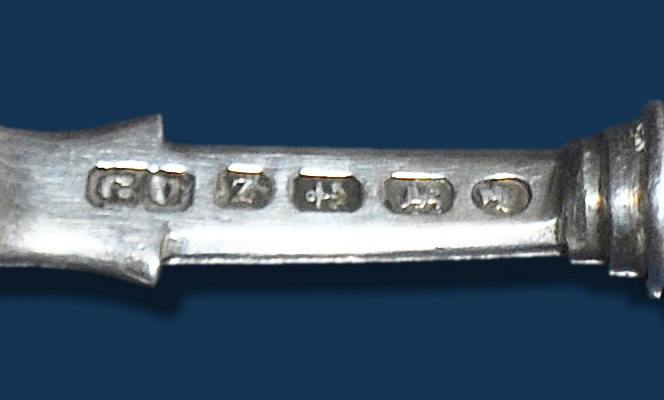
The mature classic hallmark stamp consists of multiple punches on a finished precious-metal piece:
- Maker's mark — the silversmith or workshop. Identifies who made it.
- City or assay-office mark — where the piece was tested for purity. London leopard's head, Paris fleur-de-lys, Augsburg pinecone, etc.
- Date letter — when the piece was tested. Cycles through the alphabet.
- Standard mark — the purity assayed. British sterling lion passant indicates 92.5% silver fineness.
- Duty mark or other state stamp (later additions) — confirming taxes paid or other regulatory compliance.
Architecture:
- Distributed makers: thousands of silversmiths in dozens of cities.
- Centralized verification: the assay office in each city was a single point of authority. The city mark was applied at one place, by licensed assayers operating under guild rules and (after Edward I and Philip III) state oversight.
- Verification mode: scientific. Cupellation assay testing for actual silver content.
- Persistence: durable marks on the artifact, indefinitely.
- Trust model: guild membership + licensed assayer + state oversight.
- Failure mode: counterfeiting was a serious crime, prosecuted under royal authority. The Tower Pound and other state-enforced standards underwrote the system.
(Distinction worth highlighting: hallmarking is "distributed" in the sense that thousands of independent makers participate, but it's not "distributed" in the sense that chopmarks were. Assay offices were centralized authorities operating under guild rules and state licensing. This is a hybrid system — distributed production with centralized verification — rather than a pure peer-to-peer architecture.)
System 3 — Bills of exchange (Mediterranean trade, c. 1200–1700)
The bill of exchange emerged in 13th-century Italian commerce as a tool for moving credit across long distances without moving physical specie. A merchant in Florence who needed to pay a supplier in Bruges could write a bill of exchange in Florence: an order to pay a specific sum in a specific currency on a specific date, addressed to an agent in Bruges who held that merchant's account. The supplier received the bill, took it to the named agent in Bruges, and was paid in the local currency.
The institutional roots are slightly older — the 1190s notarial register of Guglielmo Cassinese in Genoa records bank transfers between accounts within the city, a precursor to fully-fledged bills — and the form developed across the Champagne fairs in the 13th century, where merchants from Siena, Florence, Lucca, Milan, and Genoa met French and Flemish counterparties.
The mature features of bills of exchange — endorsement (transferring a bill to a third party by signing it over) and discounting (selling a not-yet-due bill at a discount for immediate cash) — emerged later than is sometimes claimed. Endorsement and full negotiability developed during the 16th century, not the 14th. Discounting matured in the 16th century as well, particularly through the great trading houses of Antwerp and the German South. By the 17th century, the system had matured into a sophisticated international finance infrastructure operated by the major Italian and German trading houses (Medici, Welser, Fugger, and their successors).
Architecture:
- Distributed actors: merchants and their agents across European trading cities.
- Verification mode: documentary. The paper bill, with signatures and (later) endorsements, was the verification record.
- Persistence: paper documents that could be physically transferred and physically retired (paid).
- Trust model: reputational. Major trading houses had reputations that backed their bills; minor merchants needed sponsorship from established firms.
- Failure mode: default by the issuing house → bill becomes worthless. Recovery required reputational damage and potential blacklisting from the network.

What the three systems share
Despite their architectural differences, the three systems share several structural features worth naming explicitly.
1. Verification distributed across many actors
In all three systems, no single actor verified everything. Verification was distributed across thousands of independent participants — Chinese shroffs, European silversmiths, Italian merchants — each handling a small fraction of the overall verification load. Even the European hallmark system, with centralized assay offices, distributed the production verification across thousands of independent makers.
2. Durable verification records
All three systems produced physically durable records of verification: chopmarks struck into silver, hallmark punches stamped on hollowware, paper bills endorsed and signed. Future participants could read the verification history from the artifact itself. The information lived in the object, not in a central database.
3. Reputation as supporting infrastructure
Even when verification was distributed, reputation accumulated. Some merchant chops became more recognizable than others; some Augsburg silversmiths became known for higher-quality work; some Italian banking houses became more trusted for honoring their bills. Reputation didn't replace verification; it supplemented it. Heavily-chopped coins were still tested by every new handler, but a familiar mark on a coin was a reasonable expectation that it had been verified by someone who knew what they were doing.
4. Failure modes routed around, not fixed
None of the three systems claimed to be perfect. When something went wrong, the failure was routed around rather than fixed. A chopmarked coin too damaged to circulate as a coin became sycee bullion. A defaulted bill of exchange devalued the issuing house's reputation but didn't bring down the whole system. A counterfeited hallmark was a crime within an existing legal system but didn't invalidate hallmarking generally. Each system carried what modern engineers call graceful degradation — alternate paths that absorbed failure without producing systemic collapse.
What the three systems differ in
The architectural differences matter as much as the similarities, and naming them carefully prevents the kind of overgeneralization that often clouds modern conversations about distributed systems.
| Dimension | Chopmarks | Hallmarks | Bills of exchange |
|---|---|---|---|
| Authority structure | No central authority. No guild registering marks. No state licensing. Pure peer-to-peer. | Guild + state oversight. City assay office is a centralized verification point. | Reputational hierarchy of trading houses; no formal governance. |
| Verification mode | Physical (hammer test of metal) | Scientific (cupellation assay) | Documentary (paper trail) |
| What's verified | The metal itself — is this silver? | The metal — what fineness? — and who made it. | The credit relationship — does the issuer's word hold? |
| Failure consequence | Coin → bullion (sycee) | Legal action against counterfeiter under royal/state authority | Reputational damage to issuing house; potential network blacklist |
| Persistence of verification | Until the coin is melted | Indefinitely on the artifact | Until the bill is paid (then physically retired) |
This matrix shows that "distributed verification" is not one thing. It's a family of architectures, each one structured differently. The Chinese chopmark system is the closest of the three to a pure peer-to-peer architecture. European hallmarking is a hybrid: distributed production, centralized verification, state-supported. Bills of exchange are a reputation-based credit network: distributed actors, hierarchical reputation, no formal governance.
What this teaches
There isn't "one" way to do distributed verification
Modern conversations about decentralized systems often imagine a single architectural pattern as "the" way to handle verification without centralized authority. The historical record shows three working patterns, each suited to different conditions:
- Pure peer-to-peer (chopmarks): works when the thing being verified is physical and inspectable on the spot, when reputational continuity is local rather than global, and when bullion fallback exists for objects that have aged out of the verification system.
- Distributed production with centralized verification (hallmarks): works when scientific testing requires specialized equipment, when guild membership and licensing can be enforced, and when state legal infrastructure can prosecute counterfeiting. This is the most state-coupled of the three.
- Reputation-based credit networks (bills of exchange): works when participants are stable trading houses with continuing relationships, when long distances make physical specie movement impractical, and when documentary records can be physically transferred. The most exposed to systemic risk: when major houses fall, the network they anchor falls with them.
Centralized authority isn't the only alternative to chaos
Each of the three systems ran for centuries — the chopmark system 250+ years, the English hallmark system in continuous use since 1300 (other European centres date back to the 1260s, with varying continuity), bills of exchange anchoring European finance for ~500 years — without producing chaos. They were not perfectly stable; each had failures, frauds, and periodic crises. But they were not fragile in the way modern conversations sometimes imagine non-state systems must be. Resilience came from structural features: distributed verification, durable records, reputation, and graceful degradation through bullion fallback or other alternative paths.
The Chinese system specifically
The chopmark system is the most fully decentralized of the three, and it's worth being specific about what made it work:
- Bullion fallback meant nothing was ever fully wasted. Even a coin too damaged to circulate retained its silver content, redeemable as sycee.
- Regional differentiation (Guangdong commodity-money vs. Jiangnan fiduciary, as documented in Essay #3) meant different parts of the empire could run different monetary regimes without conflict between them.
- Collective preference (the Carolus premium, Essay #3) meant that fiduciary anchoring could emerge without sovereign decree — the merchants chose what counted as money, and the choice held inside the community that made it.
- Physical verification at every transaction meant no one had to trust anyone else's prior work. The system was robust against the failure of any individual verifier.
Together, those four features — bullion fallback, regional differentiation, collective preference, and per-transaction verification — built a working monetary system without a sovereign-issued currency. The chopmarks are the visible artifact of one of those four pillars. The other three are equally important and equally invisible.
Lessons for modern decentralized systems
The observations that follow are not narrowly historical claims — they are inferences drawn from the historical record, carried over to modern conversations about decentralized systems. Three of them, in particular, are worth pulling out:
- Verification is not the same as trust. The chopmark system worked precisely because nobody outsourced verification to anyone else. Modern conversations sometimes conflate "trustless" systems with "trust networks" — the distinction matters. A pure verification system requires no trust at all; a trust network requires recursive trust-in-trustworthiness. Bills of exchange are a trust network; chopmarks are a pure verification system. The architectural cost of the difference is significant: bills of exchange could fail catastrophically when major houses defaulted; chopmark systems degraded gracefully because every coin had a bullion floor under it.
- Fallback paths matter as much as primary paths. All three historical systems had graceful degradation routes: bullion fallback for chopmarks, legal recourse for hallmarks, reputational consequences for bills of exchange. A system that has only one verification path is more fragile than a system with multiple paths that can substitute for each other. This is a familiar engineering principle stated for monetary systems.
- Distributed verification can run for centuries. The historical record shows that non-state monetary infrastructure isn't an exotic experiment with uncertain longevity. The Chinese chopmark system ran for 250+ years. European hallmarking is still running. Bills of exchange anchored European finance for half a millennium. The right question isn't whether distributed systems can work; it's what conditions support them and what conditions defeat them.
The full arc
- •Essay 5: Distributed Verification — Chopmarks, hallmarks, and bills of exchange (this one)
Resources and further reading
On hallmarking:
- The Goldsmiths' Company Assay Office, History of Hallmarking. Authoritative on the English system from 1300 onward.
- Étienne Boileau's Goldsmiths' Statute of 1260 (Paris) and Philip III's 1275 royal decree are the founding French documents.
On bills of exchange:
- Raymond de Roover, The Rise and Decline of the Medici Bank, 1397–1494 (1963). Classic study of the Medici banking network and its bill-of-exchange operations.
- Markus Denzel, Handbook of World Exchange Rates, 1590–1914 (2010). Comprehensive reference on the geography and mechanics of European exchange.
- John H. Munro, The Medieval Bill of Exchange (Toronto Economics, working paper). Useful overview of the technical evolution.
On chopmarks (recap of arc resources):
- F.M. Rose, Chopmarks (1987); Colin Gullberg, Chopmarked Coins: A History (2014); W. Taylor Leverage, By Weight, Not by Coyne (2023). Full citations on the Chopmarks essay.
Comparative / theoretical:
- Moneyness blog — Chopmarks and Other Distributed Validators (2014). Modern analytical piece that places chopmarking in conversation with modern decentralized-verification ideas.