The Manila Galleon: 250 Years of Silver Across the Pacific
How a single Spanish trade route — annual, hugely profitable, frequently shipwrecked — moved roughly 50 metric tons of silver per year from Mexico to China for two and a half centuries, and reshaped the global money system in the process.
In 1565, an Augustinian friar named Andrés de Urdaneta solved a navigational problem that had stumped Spanish sailors for forty years: how to sail east across the Pacific from the Philippines back to Mexico. The trade winds blow the wrong way at the equator. Urdaneta's solution was to head far north until the wind shifted at around the 38th parallel, then ride the prevailing westerlies east across the open Pacific. He made landfall near Santa Catalina Island, in modern California, and followed the coast south to Acapulco. From that voyage onward, for the next 250 years, an annual Spanish galleon left Acapulco each spring loaded with silver, sailed three months across the Pacific to Manila, and returned the following year loaded with Chinese silk, porcelain, and spices. The trade made fortunes, sank ships, and quietly rebuilt the global monetary system.
What the Manila Galleon was
Strictly, the Manila Galleon was a single annual ship — sometimes two — that ran a fixed loop between Acapulco, Mexico and Manila, Philippines, from 1565 to 1815. Westbound (Mexico to Manila) the galleon carried silver. Eastbound (Manila to Mexico) it carried Asian goods — Chinese silk, porcelain, lacquerware, spices, and luxury items that ultimately reached markets from Lima to Madrid.
More broadly, the Manila Galleon was the first commercial route to close the Pacific loop. Earlier networks — the Indian Ocean trade, the Atlantic, the trans-Saharan gold corridors — were already moving Asian goods to Europe and American silver to Spain, but as separate systems with intermediaries. With Manila, the loop closed: silver mined in Bolivia could end up in a Beijing merchant's strongbox within two years, and Chinese silk could arrive in a Madrid court within three. Dennis Flynn and Arturo Giráldez, in their 1995 paper Born with a Silver Spoon, argue that 1571 — the founding of Manila — is the more honest start date for genuinely global trade than the conventional 1492. The argument is influential and has its critics; what's not contested is that the Manila trade is the route that made closing the loop possible.
How it worked

The annual cycle
- Spring (March–April). Galleon loads at Acapulco. Cargo is primarily silver pesos — the 8 reales — typically 1 to 3 million coins per voyage, plus passengers, soldiers, and goods bound for the Philippine colony.
- Westbound voyage (~3 months). Riding the trade winds west across the Pacific. The galleons were the largest ships in the world at the time — 1,000 to 2,000 tons displacement, 300+ crew, sometimes 500 passengers.
- Summer at Manila. The galleon arrives. Chinese merchant junks from Fujian have been sailing south for weeks to meet it. The trade happens at the Parian — Manila's Chinese merchant district — over the course of weeks. Silver flows out, Chinese goods flow in.
- Fall departure. The galleon loads with Asian cargo and prepares for the return voyage.
- Eastbound voyage (4–7 months). The hard direction. Urdaneta's northern route required sailing to roughly the 38th parallel — well north of Hawaii, off the east coast of Japan — to catch the prevailing westerlies. Cold, scurvy, storms; landfall typically along the California coast near Cape Mendocino, then a coastal run south.
- Return at Acapulco. The galleon arrives between January and March. Cargo is offloaded, taxed, and dispersed. Some goes overland to Veracruz, then by ship to Spain. Some stays in Mexico for local consumption.
The financial structure
The Spanish crown licensed the trade through fixed-volume permits called the permiso. In theory, the annual westbound trade was capped at 500,000 silver pesos. In practice, actual volumes ran 5 to 10 times that — 2 to 3 million pesos in a typical 17th-century year, and as high as 4 million in peak voyages. Smuggling and underreporting were the norm; the crown periodically tried to crack down, and the trade kept growing.
The arbitrage that drove everything was real but smaller than the cinematic version sometimes suggests. In late-16th-century Spain, 1 ounce of gold bought roughly 12 to 14 ounces of silver. In China at the same time, 1 ounce of gold bought only 5.5 to 7 ounces of silver. Silver was therefore worth roughly twice as much in China as in Europe relative to gold — not five times more, as a casual reading of the ratios sometimes implies. That 2x spread was enough. Anyone who could move silver from Mexico to China at any reasonable cost was running a trade with extraordinary margins.
The spread also narrowed over time. By the early 18th century, the European ratio had widened slightly to 1:14–15 and the Chinese ratio had narrowed to roughly 1:10. By the early 19th century, the global gold-silver ratio was converging near 1:15. The Manila trade lived inside a roughly 250-year window in which Chinese demand for monetary silver kept the spread open; once the spread closed, the structural reason for the trade was gone.
The danger
The route was lethal. Of approximately 400 voyages between Manila and Acapulco from 1565 to 1815, 59 ended in shipwreck — a 15% loss rate, or roughly 1 in 7 voyages. About 90% of those wrecks happened in the western leg (the Philippines, Japan, the Marianas), where typhoons, reefs, and shoal water concentrated the danger. A separate 26 of the fleet's 108 named ships were lost to wartime capture or sinking, mostly to Dutch and English raiders.
The 1638 wreck of the Concepción off Saipan scattered its silver cargo across the reef — Spanish archives recorded roughly 5,000 coins at the time, and modern salvage has recovered only a fraction of that since. Cape Mendocino on the California coast is named for Antonio de Mendoza, the viceroy of New Spain who dispatched the earliest Pacific crossings — not, as is sometimes assumed, for a shipwreck.

And yet the trade continued. The profits on a successful voyage were so enormous that the Manila merchant community could absorb the loss of a galleon and continue operating. The Spanish crown built and replaced ships from the Cavite shipyard near Manila using local hardwood — teak and molave — that proved more durable than European oak.
Why the trade mattered
Silver flow into China — what the numbers actually were
The single most important effect of the Manila Galleon was the flow of silver into China. The peak years saw roughly 2 million pesos of silver — about 50 metric tons — pass through Manila annually for the seventeenth century, with most of it ultimately reaching China via Macao, Canton, and Fujian. Across the entire 1565–1820 span, an estimated 400 million pesos of silver — roughly 10,000 metric tons — moved through the Manila trade, of which scholars working from the silk-trade ledgers (Flynn & Giráldez; Han-Sheng Chuan) estimate around two-thirds reached China.
These figures are large but not as large as some popular accounts claim. The Manila trade was one of three major channels by which New World silver reached China; the others were European-routed silver via the Cape of Good Hope (eventually concentrated at Canton) and Japanese silver flowing through Korea and direct Chinese trade. At peak, total silver imports to China from all sources may have reached 100–150 metric tons per year. Manila's contribution was substantial — perhaps a third to half of the New World silver — but it was never the only channel.
That silver supported the entire late-Ming and Qing Chinese commercial economy. Chinese imperial taxation had shifted to a silver basis under the Single Whip Reform, systematized by Zhang Juzheng and standardized empire-wide by edict in 1581, but China had no significant domestic silver mines. The Manila Galleon was a major part of how the silver got in.

Where in China the silver actually went
The story is not flat. Different regions absorbed Manila silver differently and at different times.
Fujian — the south-coast province directly facing Manila — was the physical entry point and the merchant heartland of the trade. The Hokkien-speaking trader networks of Zhangzhou and Quanzhou ran the Chinese end of the Parian commerce, and many of the merchants whose private chops (the Manila chops discussed in Essay #1) appear on early silver coins were Fujianese. Even after the trade's center of gravity shifted, Fujian retained outsized merchant influence into the 19th century.
Jiangnan — the lower Yangtze region around modern Shanghai, Suzhou, and Hangzhou — was where most of the silver ended up. Jiangnan was the silk-and-porcelain export hub that produced the return cargo for the eastbound galleons. Silver flowed in to pay for goods that flowed out; Jiangnan grew rich and commercialized in step with the trade.
Guangdong — the southern province around Canton (modern Guangzhou) — became the dominant entry point only later. The Qing dynasty closed maritime trade as a counterinsurgency measure during the 1660s and reopened it in 1684; from the late 17th century onward, increasingly more silver entered through Canton via direct European trade (the British East India Company chief among them) rather than via the Manila route. By the 18th century, Canton was the principal silver gateway, and Manila's relative share of total silver flows was in long decline.
The trade was also not steady over time. The 1644 fall of the Ming dynasty and the wars of the Qing conquest disrupted silver flows for decades; some economic historians, drawing on work by Han-Sheng Chuan and William Atwell, argue that the silver-supply shock of the early 1640s contributed materially to the late-Ming fiscal crisis. The Qing reopening of maritime trade in 1684 restarted the flow but redirected much of it toward Canton. By the 1780s, the Manila trade was being eaten by direct British–Canton commerce, a generation before its formal end.
The chopmark connection
The earliest documented Manila chops appear on Wanli-era (1572–1620) bronze coins handled by Chinese merchants in Manila — not, initially, on silver. The practice of applying private merchant marks to silver 8-reales coins came slightly later, spreading through Fujian into Jiangnan and Guangdong over the 17th century. This dating is the consensus in the standard numismatic literature, including Cribb's 1992 British Museum catalogue and Gullberg's 2014 study.
What's worth being careful about is the causal claim. It is not the case that the volume of silver "necessitated" chopmarking — there's no monocausal story in which more silver mechanically produces more verification. The honest version is closer to this: the Manila Galleon assembled a multi-ethnic merchant context in which the normal trust mechanisms (Spanish royal assayers, Chinese imperial mints) did not extend, and which was handling silver coins of varied weight, fineness, and origin. In that context, private verification by individual merchants was the working solution. The chopmarks didn't require the volume; the volume created the context in which a verification practice could grow up. Essay #5 returns to this — it's the central claim of the arc.
What the trade left in language and money
The Spanish silver dollar that was the workhorse of this trade — the 8 reales — became the de-facto global standard coin for nearly three centuries (1530s–1850s). It circulated as a unit of account from Boston to Beijing, was struck in higher volumes than any other coin in the early-modern world, and was treated as a known quantity in markets that otherwise had no shared currency.
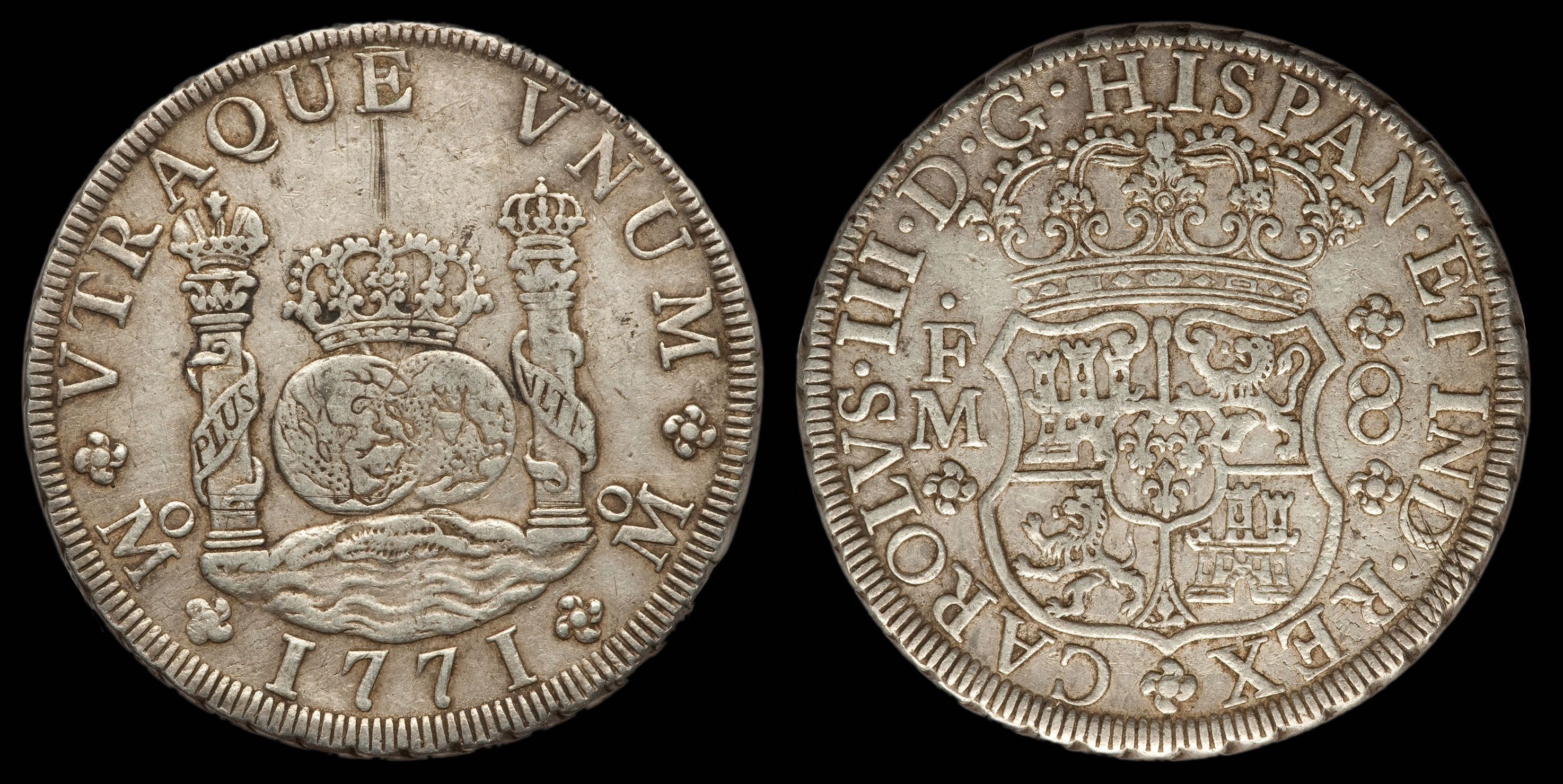
Two of the etymologies often connected to the 8 reales need handling carefully:
-
Yuan and yen both derive from the Chinese character 圓, which simply means "round." The character was applied to silver coinage when the Spanish 8 reales started circulating in volume — the round Spanish coin was distinctive in a Chinese world of square-holed cash. Yen is the Japanese reading of the same character; won is the Korean reading. So the three currencies share one etymology, not three. The Manila trade is what put the round coin in front of East Asian markets in enough volume to anchor the name.
-
Dollar. The word dollar itself does not come from the Spanish coin. It descends from the German Thaler, an abbreviation of Joachimsthaler — a 29-gram silver coin first minted in 1519 in St. Joachim's Valley in Bohemia (modern Czech Republic). The English word dollar was already in use by 1600. What the Manila trade did was give that word a new referent: by the 1580s, English speakers were calling the Spanish 8 reales a "Spanish dollar" because it traded at parity with the Thaler weight standard. When the U.S. Continental Congress chose "dollar" as the American unit name in 1785, it was choosing the word because the Spanish 8 reales — already familiar in colonial commerce as the "Spanish dollar" — was the working silver coin in the new republic.
The cultural-impact claim that survives all of this is the deeper one. For ~300 years, silver mined in Spanish America and circulated through (or via) Manila set the global price of silver, the unit of account in long-distance trade, and the physical form (size, weight, fineness) that other silver coinages would imitate when they appeared. The yen, the yuan, the rupee, the U.S. dollar — none of them are the Manila trade's children, but all of them were shaped by the standard the Manila trade carried.
The end
The Manila Galleon ended in 1815. The proximate cause was the Mexican War of Independence (1810–1821), which severed the silver supply at its source. But the trade was already dying for several converging reasons:
- Direct British–Canton commerce had been growing since the 1780s and was offering Chinese merchants better terms than the Manila intermediary route.
- The Real Compañía de Filipinas, chartered in 1785, partially liberalized Spanish trade with the Philippines, eroding the Manila Galleon's specific monopoly.
- The Napoleonic Wars (1803–1815) disrupted all Spanish trans-oceanic shipping and left the route vulnerable to British naval pressure.
The 1815 voyage was the last; subsequent voyages were attempted but didn't sustain the route. The trade infrastructure didn't disappear with it. Mexican-mined silver continued to flow to China, now via European intermediaries through Canton and (after 1842) Hong Kong. The Carolus dollar coins that had crossed on the galleons remained in Chinese commerce for decades and traded at premium until the late 19th century — the subject of Essay #3.
By the time the Manila Galleon ended, the system it had helped build was robust enough to continue without it.
What this teaches
Three things are worth pulling out of the Manila Galleon as a working historical system:
- Persistent regional price differences can survive for generations when the friction of moving the commodity is high. The 2x silver-arbitrage spread between China and Europe didn't close for roughly 200 years. Modern markets close arbitrage in seconds; pre-industrial markets could leave it open for the lifetime of a state. The Manila Galleon is a reminder of how long economic disequilibria can persist when the cost of equilibration is itself enormous.
- A trade route that runs long enough becomes infrastructure, not just commerce. Once the Manila silver flow was embedded in the Chinese tax system, the silk-and-porcelain export economy, and the merchant networks of three Chinese provinces, ending the trade did not unwind any of those structures. They kept going under different management. Tax systems and monetary expectations have inertia; once you build them around an inflow, you don't get to easily turn the inflow off.
- A commercial system can absorb staggering individual losses if the surviving voyages pay enough. Losing 1 in 7 galleons should have been crippling. It wasn't, because the Manila merchant community functioned as a kind of self-insuring pool — the successful voyages were profitable enough that the community could collectively absorb shipwrecks no individual could afford. This is not the modern hedge-fund argument it sometimes gets read as. It's an older idea: a commercial guild whose collective survival depends on collective gain.
The chopmarks discussed in Essay #1 are the visible artifact of the verification system that grew up around this silver flow. The Manila Galleon assembled the merchant context in which private verification became a workable substitute for state-issued trust. Without the trade, the chopmarks have no reason to exist.
The full arc
- •Essay 2: The Manila Galleon — 250 years of silver across the Pacific (this one)
Resources and further reading
- William Lytle Schurz, The Manila Galleon (1939). The classic English-language account of the trade. Long out of print but widely available used.
- Andrew Peterson, What Really Made the Eighteenth-Century Trans-Pacific Galleon Trade Possible? Circulation and Asymmetries of Information in the Hispanic Pacific (2014). Modern academic treatment with attention to institutional and informational infrastructure.
- Dennis O. Flynn and Arturo Giráldez, Born with a Silver Spoon: The Origin of World Trade in 1571 (Journal of World History, 1995); Cycles of Silver: Global Economic Unity through the Mid-Eighteenth Century (Journal of World History, 2002). The influential argument that 1571 marks the start of true global trade, and the broader silver-cycles framework.
- Richard von Glahn, Fountain of Fortune: Money and Monetary Policy in China, 1000–1700 (UC Press, 1996). The standard English-language work on Ming-Qing monetary history, including gold-silver ratio data.
- Han-Sheng Chuan, The Inflow of American Silver into China from the Late Ming to the Mid-Ch'ing Period (Journal of the Institute of Chinese Studies, 1969). Foundational work on the volumes and timing of silver inflows.
- Maritime Disaster in Spanish Philippines: The Manila-Acapulco Galleons, 1565–1815 (IJAPS, 2015). Modern compilation of the full voyage and shipwreck record.
- Carmen Yuste López, Emporios Transpacíficos: Comerciantes Mexicanos en Manila, 1710–1815 (UNAM, 2007). Spanish-language but the standard work on the late-period merchant community.