Sycee: The Bullion Form That Quietly Ran an Empire
While Chinese merchants chopped foreign coins for daily commerce, the largest transactions in Qing-era China happened in a different silver form altogether: hand-cast bullion ingots called sycee. Outlawed in 1933 — but their shapes still appear in dumplings, decorations, and joss paper today.
If you'd asked a 19th-century Chinese merchant in Shanghai or Hangzhou what the most important form of silver in their economy was, they wouldn't have said the Spanish Carolus dollar or the Mexican peso. They would have said sycee — hand-cast silver ingots, shaped like boats or saddles or drums, stamped with silversmith marks and the city of origin, used for every large commercial transaction in the empire. The form had been used for centuries; the boat shape standardized in the Yuan dynasty and the name yuanbao was already in circulation by the Tang. By the time the Republican government outlawed sycee in 1933, it had quietly run a parallel currency system alongside foreign coins for hundreds of years. Its shapes still appear today — in the gold yuanbao decorations sold at Chinese New Year, in the boat-shaped jiaozi (dumplings) eaten on New Year's Eve specifically because they look like ingots, and in the joss paper burned at graves. The bullion is gone; the iconography is everywhere.
What sycee was
sycee is the English term — first attested in 1711, derived from the Cantonese xisi (or sai sze), literally "fine silk" — for hand-cast Chinese silver bullion ingots used as currency. The Mandarin term is yuanbao (元寶), meaning "primary treasure" or "original treasure." The name is older than the boat shape: it derives from Kaiyuan tongbao (開元通寶), a Tang dynasty (618–907) cash coin first cast in 621 under Emperor Gaozu — its inscription 開元 means "to inaugurate a new epoch," not a reference to the later Kaiyuan reign era (713–741); yuanbao was the abbreviated form, eventually applied to Chinese silver ingots more broadly.
Each ingot was cast individually by a silversmith. The molten silver was poured into a mold (often a stone mold for the boat shape, or specific regional forms for other shapes). As the silver cooled, the silversmith would tap or rock the mold to encourage the formation of fine concentric ripples — the xisi or "silk-pattern" that gave the form its English name. After cooling, the silversmith stamped the ingot with their identifying mark, the assayed purity, and often the year and city of origin.
Sycee circulated by weight, not by face value. Every transaction involving sycee required weighing the ingot on a dotchin scale and computing the value at the local tael standard. For the largest commercial transactions in China — interregional trade settlements, tax payments, banking transfers, capital deployment — sycee was the dominant form.
When sycee began
The dating question is easy to flatten. Some Chinese-language sources trace silver ingots used as currency back to the Qin dynasty (221–206 BC), and primitive cast-silver bullion forms certainly existed by Han times. Earlier gold ingots — the famous Han-dynasty "horse hoof gold" (mati jin) — are well-documented. But the recognizable sycee form, with its standardized cast-and-marked structure and the yuanbao terminology, is a much later phenomenon.
The dating consensus in the standard numismatic literature — Cribb's 1992 British Museum catalogue is the definitive English-language reference — runs:
- Tang dynasty (618–907): the yuanbao name enters use, derived from the Kaiyuan tongbao cash (first cast 621; its inscription means "a new beginning," not the later Kaiyuan era). Bullion-form silver of this period exists but is irregular.
- Song dynasty (960–1279): lotus-shaped silver ingots emerge as the recognizable precursor of the boat form. Reign titles begin appearing on the marks.
- Yuan dynasty (1279–1368): the boat shape standardizes and yuanbao becomes the dominant form for large-denomination silver bullion.
- Ming and Qing dynasties (1368–1912): the form matures; regional shapes diverge; silversmith marks, fineness assays, and provincial provenance become standard inscriptional elements.
The shorthand "earliest sycee = Qin dynasty" conflates cast-silver currency in general with the recognizable sycee form. The recognizable form — boat-shaped, stamped, xisi-patterned, regionally varied — is a Yuan-and-later phenomenon. Earlier silver bullion existed under different names.

Regional shapes
The most distinctive feature of sycee is regional variation. Each major region of China cast sycee in a characteristic shape, and the shape was effectively a regional signature. An assayer in Beijing could often identify a sycee's province of origin from form alone, before reading the stamped marks.
Boat or shoe shape (yuanbao proper)
The most common form, used throughout most of China except the southern coast (Guangdong) and the western regions. The classic "boat" shape has a curved bottom, raised ends, and a hollow upper surface where the silk-pattern formed during cooling. Common weights ranged from 1-tael fractional pieces up to 50-tael large ingots. A standard 10-tael boat sycee measures approximately 73×40×38 mm and weighs about 343.8 grams at 96%+ silver fineness.
This is the shape that became iconic in Chinese culture — the silhouette that today appears in jiaozi (dumplings), gold yuanbao decorations, joss paper, and feng shui wealth symbols.

Packsaddle (packsaddle sycee)
Used predominantly in Yunnan province, where it's known locally as ma'an ding — "horse-saddle ingot." Saddle-shaped, with a curved upper surface and two raised ends, designed to sit balanced on a flat surface. Yunnan was a major silver-producing region during the Qing dynasty, and the packsaddle form was used for tax payments and large commercial transactions within the province. A 5-tael packsaddle measures approximately 62×40×17 mm and weighs about 180 grams at ~96% purity. Cribb's catalogue records small numbers from neighboring Sichuan and Guizhou as well, so the form is predominantly — not exclusively — Yunnanese.
Snail (yuansi)
A small hemispherical ingot with raised rims and pits on the bottom, resembling a snail or shell. Used in southern Yunnan and — significantly — also adopted by the Shan peoples of northern Burma and northern Thailand for cross-border commerce. A typical example weighs around 58 grams in a hemisphere about 31mm in diameter and 21–25mm tall. The cross-border use is direct evidence that sycee circulated beyond imperial Chinese borders into mainland Southeast Asia, in regions where local trade communities preferred the form. The Shan adoption is documented in dealer literature and Cribb's catalogue, though mainstream academic sources don't treat it extensively.

Drum
A roughly cylindrical Sichuan form with raised rims at top and bottom, resembling a small drum. A 10-tael drum sycee measures approximately 58×52×27 mm and weighs about 355 grams. Used primarily in Sichuan and surrounding areas.
Other regional forms
- Three-stamp remittance: Yunnan and other tax-payment contexts. Rectangular bars stamped with year, location, and silversmith marks — three distinct stamps in series. Used as audit-traceable tax payments to the imperial treasury.
- Square loaf: Larger denominations (50-tael and above), various regions.
- Tortoise: Some regions; symbolic longevity association.
- caoding (oval): Sichuan and Shaanxi, per Cribb's classification.
- yuanding (round): Sichuan eastward to Jiangxi. Scarcer than the caoding.
The regional differentiation isn't accidental decoration. It's a working signature system: every sycee told you its origin region by form alone, before you read its stamps. Local silversmiths competed within regional shape conventions, not against them.
How sycee functioned in commerce
Tax payments
The Qing imperial government taxed in silver, using the kuping tael standard (~37.3 grams) — distinct from the lighter Shanghai commercial tael (~33.9 g) and the heavier customs (Haiguan) tael (~37.8 g) used elsewhere in trade. Provincial tax obligations were collected in sycee, then physically transported to the capital. The three-stamp remittance bars from Yunnan are the visible trace of this — each bar carries the year, the issuing prefecture, and the silversmith who cast it, providing an audit trail for the imperial treasury.
Interregional commerce
Major Chinese trading houses operated networks across multiple provinces. Settlement of trade balances between regions happened in sycee — the only silver form universally accepted across the empire (modulo the regional shape preferences). A merchant in Shanghai who needed to settle accounts with a partner in Sichuan would convert his Shanghai-tael sycee into a form acceptable in Sichuan, often by physically melting and recasting at a local silversmith.
Banking
Late-Qing Chinese banking — particularly the Shanxi banks (piaohao) — operated on a sycee reserve. Bank notes were issued against silver reserves held in sycee form. The shape and stamped marks of the sycee held in reserve were part of the bank's accounting record. When a bank failed, the sycee in its vault was distributed to creditors at its bullion value.
The xisi — silk pattern as purity indicator
The English word "sycee" comes from the Cantonese term for "fine silk" — referring to the silk-like ripple patterns that form on the surface of cooling high-purity silver. The phenomenon, called xisi, was treated by Chinese assayers as a visible indicator of silver fineness.
When high-purity molten silver is cast and tapped while solidifying, fine concentric ripple lines appear — visually similar to the folds of woven silk. The phenomenon is real, and it correlates well enough with purity that assayers treated the surface itself as a reliable eye test for near-pure silver — no destructive assay required. Sycee of the standard mid-Qing period was refined from the ~0.903-fine Spanish-American 8 reales to a Chinese standard of 0.980 — and the silversmith's xisi surface was part of the visible record of that refining work.
The rippling-on-purity correlation is widely documented in numismatic and assayer-tradition sources. Whether it's a strict metallurgical phenomenon — high-purity silver crystallizing differently in a textbook physics-of-solidification sense — or an empirical practitioner's metric that happened to track purity well enough to be reliable, the sources don't fully resolve. What is settled: the correlation was working knowledge among Chinese assayers, and the silk surface was the visible test they used to estimate fineness.
The cultural afterlife
Sycee as a circulating monetary form ended in 1933, when the Republican Chinese government abolished sycee and the tael as legal monetary forms in favor of the silver dollar. Two years later, the November 1935 fabi reform nationalized silver dollars themselves and replaced them with paper currency. Two parallel non-state monetary systems — chopmarked foreign coins and locally-cast sycee — were ended within two years of each other by the same modernization push.
But the iconography never went away. Sycee shapes — particularly the boat-shape yuanbao — persist as wealth symbols in Chinese culture today.

Chinese New Year
Gold-painted yuanbao decorations — replicas of the historical boat-shape ingots — are sold by the millions for Chinese New Year celebrations across China, Taiwan, Singapore, Malaysia, and Chinese diaspora communities globally. Hung in homes and shops, displayed on altars, used in street decorations, the yuanbao silhouette is one of the most recognizable wealth symbols in modern Chinese culture.
Jiaozi (dumplings)
Jiaozi — Chinese dumplings traditionally eaten at New Year's Eve — are shaped like sycee. The classic crescent fold of a jiaozi mimics the boat-shape yuanbao silhouette. The connection isn't accidental; it's the explicit cultural reason why dumplings are eaten at New Year. Folding yuanbao-shaped jiaozi at the family dinner the night the year turns is a wish for prosperity in the new year, materialized in the food.
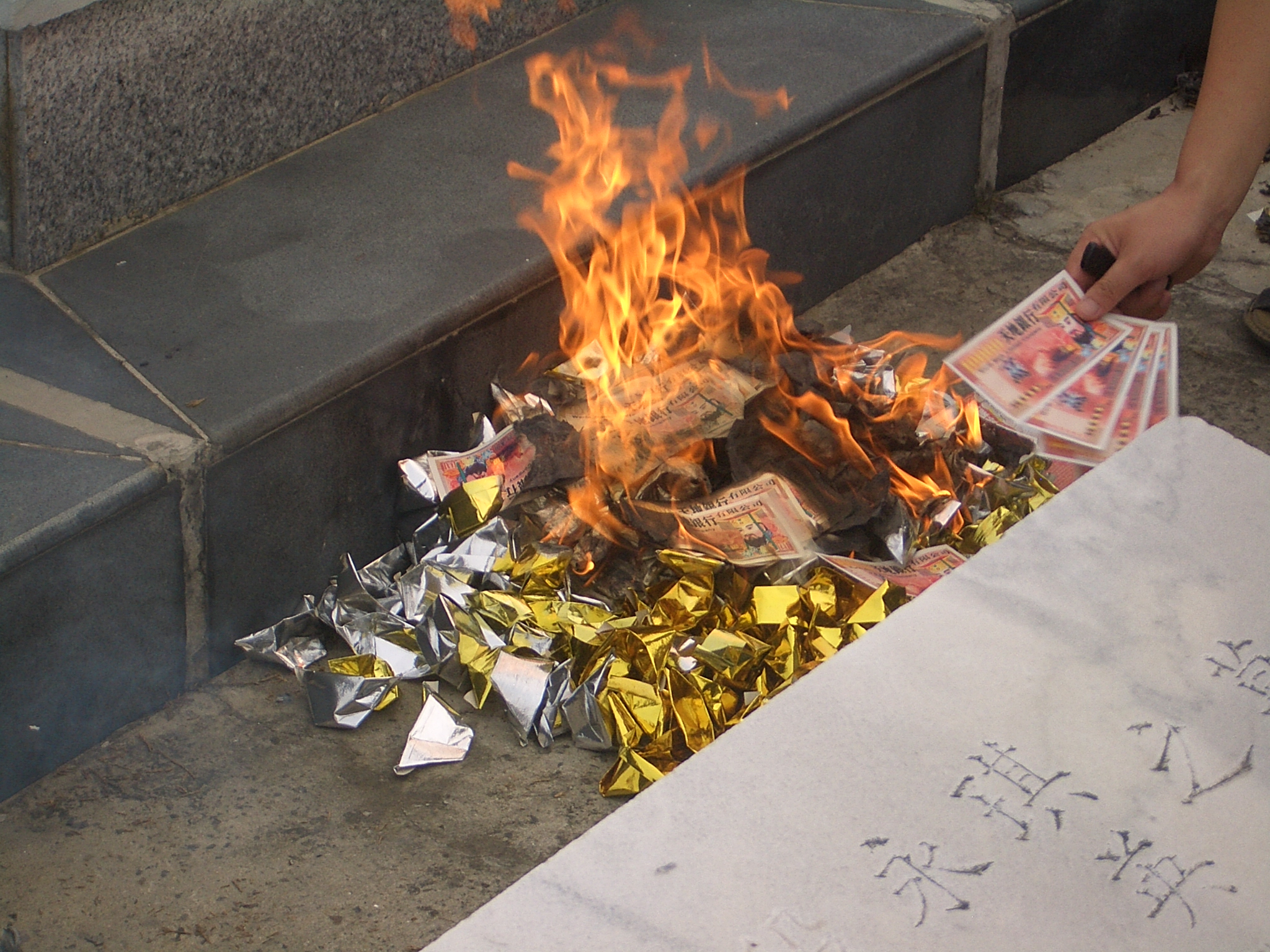
Joss paper
Paper offerings burned at graves and ancestral shrines often include yuanbao-shaped paper money — gold-foil-covered sheets folded into boat-ingot shapes, sometimes called "spirit money." The deceased ancestor receives wealth in the form their generation would recognize: not modern banknotes, but the historical yuanbao.
Feng shui
In feng shui practice, golden yuanbao objects are placed in homes and businesses as wealth attractors — particularly in the southeast "wealth corner." Decorative ingots in living rooms, on altars, and in commercial premises persist as part of contemporary Chinese spatial-luck practice.
The form is dead as money. As iconography it's everywhere.
What this teaches
Sycee runs alongside and underneath the chopmarked foreign coins discussed in Essays #1 and #3. While merchants stamped Carolus dollars and Trade Dollars for daily transactions, the largest transactions in Chinese commerce — taxation, interregional trade settlement, banking — happened in this regionally-varied bullion form.
Three things stand out:
- Regional differentiation as a feature, not a bug. The regional shape variation isn't an inefficiency that should have been standardized away. It was a working signature system: shape encoded origin, and origin carried information about the issuing silversmith and assay tradition. Local silversmiths competed within regional shape conventions, not against them. Standardizing across regions would have erased information, not added efficiency.
- Bullion as a fallback for everything else. When a foreign coin lost its fiduciary status — became too worn, too chopped, too unidentifiable — it could always be melted into sycee and re-enter the local economy as bullion. This is the floor under the entire monetary system: no value was ever lost, because the silver always had its bullion value, and sycee was the standard form of that value.
- Cultural persistence beyond economic function. Sycee is dead as money. It's been dead for nearly a century. But the form is alive in dumplings, decorations, paper offerings, and feng shui placements — passed down through generations of people who never used the historical ingots in commerce. Iconography outlasts the system that produced it. The cultural memory of how the empire's commerce was conducted is preserved in eating dumplings on New Year's Eve.
The full arc
- •Essay 4: Sycee — The bullion form that quietly ran an empire (this one)
Resources and further reading
- Joe Cribb, A Catalogue of Sycee in the British Museum (1992). The definitive English-language sycee reference. Documents some 1,300 sycee — including a section on forgeries — with shape and provincial assignments.
- Hosea Ballou Morse and A. Théophile Piry, The Trade and Administration of the Chinese Empire (1908). Period economic-history reference. Documents use of sycee in Qing-era commerce. Available digitized via Google Books.
- Money Museum (Zurich). High-quality images of Qing dynasty boat sycee and other monetary artifacts.
- Stack's Bowers auction archive. Searchable archive of sycee that have come to market, with detailed descriptions and high-resolution photography.
- Journal of East Asian Numismatics — Introduction to Sycee. Modern overview with attention to silver fineness, the xisi phenomenon, and regional shape catalogues.